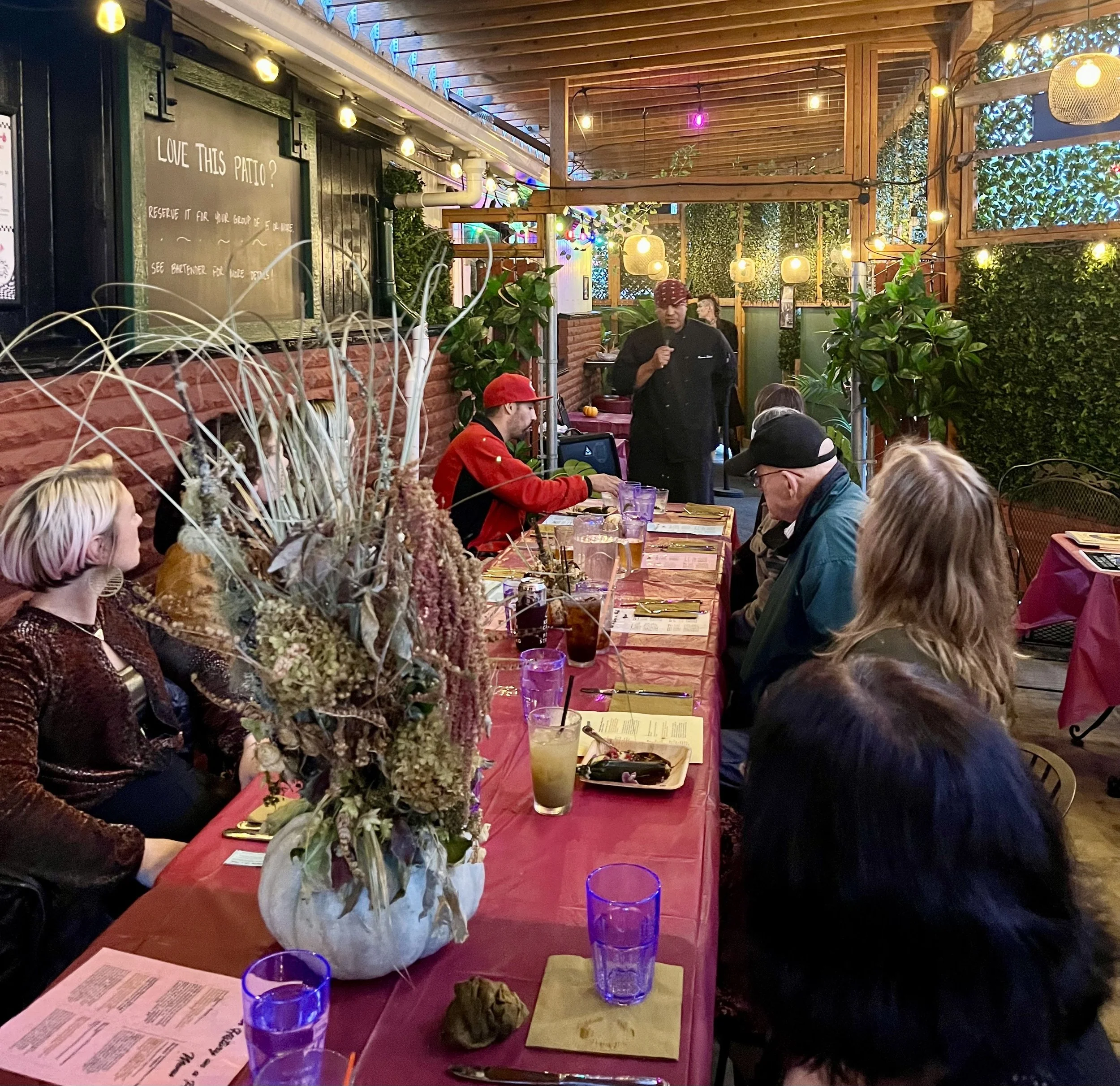
Late last month, a varied group of writers, scholars, and labor activists gathered in Portland for a panel discussion on labor, food, and immigration policy. Among the panelists were Larry Kleinman, Secretary-Treasurer for PCUN; Mary Mendez, Deputy Director of Enlace; and Paul Apostolidis and Aaron Bobrow-Strain, both authors and professors at Whitman College. While the evening began with the panelists praising Slow Food for convening around these issues of food and labor, they each quickly dispensed with the formalities, and began to lance many of the common precepts and comfortable foundations of our movement.
Through each of their remarks, the groups launched a well-constructed —and constructive— critique of the common, market-based approach to food reform. “The American agrarian ideal of the small family farm is largely a myth,” began Bobrow-Strain. Throughout history, as he went on to explain, American food reformers have latched onto this model as the golden alternative to food system woes. The issue, however, is this was never really the reality. “Even Ma and Pa Engels of Little House on the Prairie,” said Bobrow-Strain, “were not early Wendell Berrys; they were serf farmers, scattered across the Midwest, beholden to Eastern landowners, and dependent on selling their wheat to England in order to eke out a living.” By idealizing a past that never happened, we’re imagining the realities of labor right out of the equation. Essentially, food reform has often pre-supposed, or required, an invisible labor force.
Apostolidis expanded on this point, explaining that when faced with worker injustice, we often retreat to a position of “moral benevolence:” though moved by the social injustices of what we see, we are still removed from the people involved. When we pity the conditions and can’t bear to support the companies that create them, then we seek out alternatives in the marketplace and hope that our boycotting will have an impact on the mainstream product. In practice, this approach to food labor reform relies on Bobrow-Strain’s “American agrarian ideal;” it presupposes a vibrant community of small-scale, financially-solvent farmers ready to serve as counterpoint to industrial production. However, even among the farmers at local markets, many must still employ low-wage migrant workers, because few farmers themselves are adequately compensated for their own labor. This approach only further divides the consumer from the producer. Read more
Our good friends at Ned Ludd (who hosted our November event with the women cattle ranchers of Eastern Oregon), have an incredible guest visiting this coming Monday.
Joel Salatin, the American ‘beyond organic’ farmer, lecturer, and author prominently featured in the new documentary, FRESH, as well as in Michael Pollan’s book, The Omnivore’s Dilemma, will be in Portland on Monday, April 19th. Joel will give two lectures at the Tiffany Center at 6pm & 8pm. Ned Ludd will host an intimate lunch with Joel at noon.
Location: 3925 NE MLK Jr Blvd Portland, OR 97212 (503) 288-6900 Tickets: $115, 32 seats available
If you can’t get a seat at the meal, but would still like to hear Salatin speak, you can catch him in either of two (!) lectures.
Lecture 1: Monday, April 19th, 6pm
THE SHEER ECSTASY OF BEING A LUNATIC FARMER: In this mischievous lecture, Joel Salatin compares the industrial global food paradigm with the heritage local food paradigm. Using hilarious stories from his family’s Polyface Farm experience, Salatin examines the contrast on many different levels: fertility, carbon cycling, energy use, relationships, marketing, and spirit. If you ever wondered: “What’s really the difference between pastured poultry and Tyson’s?” –now you’ll know.
Lecture 2: Monday, April 19th, 8pm
CAN YOU FEED THE WORLD?–ANSWERING ELITISM, PRODUCTION, AND CHOICE:
By far and away the two most common questions asked of Joel Salatin are: How can we afford local artisanal heritage-based food and is it realistic to think we can really feed the world with a non-industrial food system? Because the local clean food movement, for all its allure, is still only 2 percent of all food sales, envisioning it as a credible, viable alternative to industrial corporatized genetically modified food seems like pie-in-the-sky dreaming. Using his own Polyface Farm principles as a foundation, Joel builds this vision one piece at a time by blending theory and practice. You will never think about the food system the same way again
Location: Tiffany Center: 1410 Southwest Morrison Street, Portland, OR 97205-1930 (503) 522-4467 Tickets $25
Buy tickets from the link on our homepage: www.FRESHthemovie.com, or through www.brownpapertickets.com (type “Joel Salatin Portland” in the search window).
About FRESH:
FRESH celebrates the farmers, thinkers and business people across America who are re-inventing our food system. Among several main characters, FRESH features Milwaukee urban farmer and activist, Will Allen, the recipient of MacArthur’s 2008 Genius Award; sustainable farmer and entrepreneur, Joel Salatin, made famous by Michael Pollan’s book, The Omnivore’s Dilemma; and supermarket owner, David Ball, who is challenging our Wal-Mart dominated economy.
Written by Brady Walen, Slow Food Portland Time for Lunch Coordinator & Jen Michaelis Van Arkel, Slow Food Portland Time for Lunch Committee Member
Over the past several months, Slow Food chapters around the country have been promoting the Time for Lunch campaign in an effort to provide children with real food at school. Locally, Slow Food Portland has had a committee of dedicated volunteers working to bring awareness to the campaign, and to encourage people to show their support for this important issue in signing petitions, writing letters, and calling Oregon State representatives.
The Time for Lunch program emphasizes an important point:
“Right now, Congress leaves school lunch programs with only $1 per meal to pay for food. Schools do their best to stretch that dollar, but it’s simply not enough to provide kids with the food they need to stay healthy and to perform well in the classroom.”
In our work to generate awareness about Time for Lunch, we posed the question to ourselves:
Can we make a meal for a dollar?
As a team, we were blown away to learn that people responsible for school lunches across the country have an average budget of just one dollar per child per day. We agreed: one dollar just doesn’t seem like enough to nourish kids for an energetic day at school. What on earth could you make with one solitary dollar?
For most, the best way to learn is by doing. So we challenged ourselves and some friends to cook a healthy meal for one person, with one dollar. We called it the Dollar Meal Challenge.
We gave ourselves a week to come up with a healthy, tasty meal. Staple pantry items and anything we could pull from our home gardens were considered freebies (they didn’t count towards the $1 budget). Fresh ingredients were encouraged, and extra points were scored for anything organic and/or local. We made a Flickr site where we could inspire each other with photos of our concoctions and share stories about our experiences. It was challenging, but at the end of the week, we had a diverse collection of delicious meals all made for about a dollar per serving, with taster reports to prove it.
Cannellini Bean Stew with butternut squash and kale over crispy polenta
Beet Risotto with Beet Greens
Sauteed Chickpeas with cinnamon & coriander, roasted carrots with balsamic glaze, and butterred brown rice
Curry Ginger Millet with peas, raisins, and fennel
“Sauteed Chickpeas with Cinnamon and Coriander: Salt, a squeeze of lemon and a sprinkling of cilantro make it fresh and tasty. A great source of protein on a budget. My kids eat ‘em like candy.”
“It was fun … it was challenging and ended up being delish.”
Beyond being a fun twist on the otherwise hum-drum “What’s for dinner?” conundrum, the experience also gave us a humbling taste of the obstacles school lunch staff face every day. Some people commented that the budgetary constraints forced them to rethink where they shopped so they could get the best deal.And favorite ingredients, including fresh produce and some proteins, were suddenly prohibitively expensive. Others remarked how much more time it took to come up with a menu that fit the challenge’s criteria.
“95¢! I shopped at Winco, The same meal from New Season’s totaled $2.16”
“Had to forgo organic products (too bad).”
“It’s disconcerting how little fresh food you can buy on this budget.”
While we were optimistic after putting together a few successful dishes, we realized that our meal and ingredient options are extremely limited when we only have $1 to spend. Expensive items like meats for example are cost prohibitive. And while we were able to create single meals for $1 per serving, we need to remember that those responsible for school lunch decisions are working with a very limited budget everyday; the current amount doesn’t allow for the kind of variety children need for a well balanced meal from one day to the next, and one week to the next.
$1 is simply not enough to provide a healthy variety of foods for school lunch. This is why we are asking for your support with this important issue.
In this week’s Slow Food USA news, we learned that ” the Senate Agriculture Committee unanimously approved its bill to update child nutrition programs (the Healthy, Hunger-Free Kids Act). The bill will now go to the Senate floor at a date to be determined, no earlier than mid-April. And, On the same day that the committee approved the bill, Slow Food USA’s Time for Lunch Campaign surpassed its goal of sending 100,000 letters and petition signatures to Congress. The momentum’s still growing—click here to learn how you can help out. Please visit the Slow Food Time for Lunch website to learn more about the campaign, follow news and progress, and to get involved.
We’d also encourage you to participate in the Dollar Meal Challenge. Can you make a meal for a dollar or less per serving? Try it out. Feel free to share your stories, ideas, and questions through the comments on this post.While you may find making a healthy meal for a dollar to be a difficult task, remember that this is a challenge faced by those responsible for preparing, cooking, and serving school lunches to our children on a daily basis - and it’s time to change that.
This video has certainly made the rounds on the internet recently, but the message is timely, important, and well-worth sharing again. Here’s the speech British celebrity chef Jamie Oliver’s delivered to TED in February, in which he talks about the need to combat our children’s ignorance about healthy and sustainable eating:
While here in the states we often think of Mr. Oliver as simply a happy-go-lucky television personality, in Britain, he has a long history of using his celebrity to expose the failures of our modern, industrial food system. Now, he’s hopped the pond to take on the struggles of American eating, and has started his own “revolution.” To learn more about his work in the US, check out jamieoliver.com.
Our friends at the wonderful Zenger Farm are holding a springtime fundraiser in support of their educational programs. Between March 14 and 20, a slew of local restaurants and nurseries will donate some of their proceeds to Zenger. A few of these sound pretty good to us… So keep up the great work, guys!
Over the past two years, we’ve tried to keep you up-to-date on the Urban and Rural Reserves process for the Metro region, which will determine how rural lands are protected at the edges of our Urban Growth Boundary. As the final votes on Washington County Reserves quickly approach, we share this message from our partners at 1,000 Friends of Oregon, urging you to take action and let the Metro Council hear your voice.
This Thursday, the Metro Council will make its final decision on Rural and Urban Reserves for the Metro region, and it looks like it will be business as usual. Instead of embracing the opportunity to protect farm and forest land and natural resources for the next generation, it looks like a majority of the Metro Council may vote to make land available for sprawling urbanization for the next land development.
We need you there.
The Reserves process is supposed to protect the heart of the region’s farm land and significant natural resources for the next 40-50 years, while also providing some areas for urbanization over that same period. Clackamas and Multnomah counties, and the cities in those counties, conducted a thorough analysis of their future urban needs and balanced them with the needs of food and fiber production and natural resources. Both urban and rural reserves in those areas reflect that balance.
Washington County did not. Urban reserves are slated for thousands of acres of the region’s – and indeed the nation’s – most valuable farm land, in the heart of the Tualatin Valley. The proposed urban reserves in Washington County represent a noose of urbanization slowly tightening around the Tualatin Valley - north of Cornelius; north, west, and south of Hillsboro; and around North Plains. Washington County has taken a very short-sighted view of economic development – as though more land is all it takes.
A majority of the Metro Council stands poised to approve this.
Please email Metro Council and your County Commisioners (emails below) or attend the final Metro hearing and testify or to show support for local agricultural and natural resources. We will have stickers for you to wear showing you care about local farms. If you plan to attend the hearing, please contact 1000 Friends Field Organizer, Tara Sulzen, to let her know so she can keep an eye out for you or answer questions regarding testimony.
Those wishing to testify will have 1 minute to do so. Let the Metro Council know that this is their “Senate Bill 100 moment.” That’s the bill that established Oregon’s land use planning system – it’s why this is a place we all want to call home today. Will our children?
Date: Thursday, February 25 Time: 2:00 pm
Place: Metro Council, 600 NE Grand Ave, Portland, OR
This week, The Oregonian ran a short article about an exciting pilot program taking off in Forest Grove. The new program - which is run by the Hispanic women’s development group Adelante Mujeres - provides and farm land and training to Latinos who’d like to practice organic agriculture. While Latinos make up an overwhelming majority of farm laborers statewide, very few own and operate their own farms. According to Alejandro Tecum, director of the agriculture project, “Many Latinos grew up in the fields and know a lot about farming. When they move here, they miss this contact with the earth. We see the people’s happiness when they come to farm, to be able to cultivate the land once again.” The group, which also runs the Forest Grove Farmer’s Market, hopes that the recent $300,000 federal grant they received will help new Latino farmers to learn alternatives to the conventional, chemical-intensive agriculture practiced on many farms.
This is a very inspiring project taking place right in our local counties, and a good reminder of the breadth of issues surrounding farm labor. While working conditions for Latino farmworkers have garnered more attention over the past year, very few people make the leap to consider what it takes to assist Latinos in starting their own economic enterprises and farms. But that’s not to say that the issue has been entirely overlooked in Oregon, either. The fledgling Adelante Mujeres project will find good company in a similar program run by Zenger Farm, The Immigrant/Refugee Farmer Training Program. With the support of the surrounding community, there’s hope that these programs will be just the first step towards sustainable, farm-based economic development for many new populations.
Make sure to read the full article on the farmer training program, and also check out this Oregonian article on Adelante Mujere’s farmer’s market cooking.
We’re a few days into 2010, and it’s time to start taking stock of just how exactly we’ll all hold true to our New Year’s resolutions. Maybe you swore to cook more foods from scratch. Maybe you resolved to raise a larger garden this year. Whatever new food promises you made, it’s always helpful to seek out some expert advice on the subject. Luckily, this is the perfect time of year to enroll in a workshop and learn how best to accomplish your Good, Clean, and Fair food goals. We recently mentioned a series of intensive Oregon Tilth Classes, but if those courses seemed a bit more “urban farmer” than “kitchen gardener,” you’ll be happy to hear that Portland’s Bureau of Planning and Sustainability has tripled their already diverse workshop offerings for this year’s Urban Growth Bounty series.
Classes take you from seed to table (or egg and hive to table!) and cover subjects including fruit orcharding, urban beekeeping, gardening, cheesemaking, preserving the harvest, and how to make delicious meals from the foods you’ve raised. The series offers some incredible opportunities to learn from some knowledgeable Portland food figures, including cookbook author Ivy Manning, community-supported kitchen owner Tressa Yellig, backyard apiarist Glen Andresen (featured on last summer’s bike tour), and farmer (and Slow Food Portland committee member) Josh Volk.
To learn more and enroll in workshops, check out the class lineup here. Just don’t be surprised if your list of resolutions grows when you see all of the great subjects you could cover!
You might be thinking that it’s too early to planning for next year’s harvest, but Oregon Tilth is already booking out their gardening classes for 2010! Each year, Oregon Tilth hosts a broad lineup of courses for beginning and advanced gardeners alike. Their workshops cover subjects including year-round gardening, intensive urban agriculture, container gardening, garden planning, and fruit tending. A (lengthy) list of their just-announced classes follows the jump. Take a look and get a head start on sowing your crops!
We don’t normally post employment opportunities, but this particular position is too important for us to let it slide under the radar. Oregon Department of Agriculture is hiring a Farm to School Coordinator, and the application deadline is coming up fast. As Slow Food joins other organizations in continuing to push for school lunch reform, the Farm to School Coordinator will be someone whom we all depend on to facilitate farm to school connections and enhance the use of local products in our cafeterias. If you are someone who is uniquely qualified for this challenge, or if you know someone who is, please take a look at the job posting here. The deadline for applying is this Friday, November 13th.